
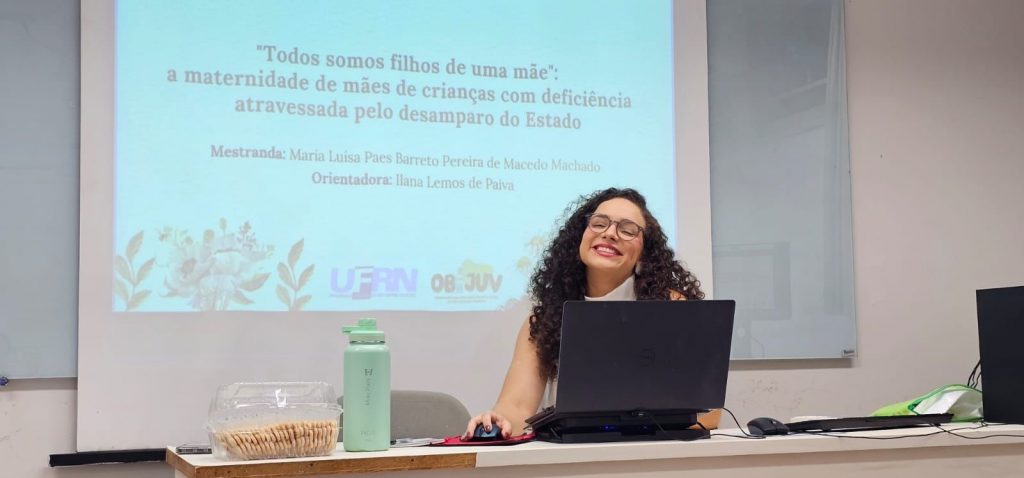
Research developed at the Federal University of Rio Grande do Norte (UFRN) investigates the motherhood experience of women who care for children with disabilities, focusing on Trisomy 21, a genetic condition known as Down Syndrome.
The study was authored by clinical psychologist Maria Luísa Paes, master from UFRN, supervised by professor Ilana Lemos de Paiva and member of the Observatory of the child and youth population in contexts of violence (OBIJUV).
The research analyzes state helplessness as an expression of the capitalist organization of life, based on historical-dialectical materialism and articulating contributions from Marxist feminism, the Theory of Social Reproduction and Emancipatory and Feminist Disability Studies.
Qualitative in nature, the study was carried out based on interviews with 10 women from the Mães T21 RN collective, residing in Rio Grande do Norte, covering different ethnic-racial self-declaration, income, sexual orientation and territorial contexts.
The results indicate that care is socially distributed unequally, remaining concentrated on women and marked by overload due to insufficient state support. The analysis also points out that the maternal experience is crossed by fear related to the possible health demands of their children and by the perception of society's discriminatory outlook.
According to Maria Luísa, it is necessary to expand the debate on the conditions of these women. "There is an urgent need to reflect on the living conditions and overload of mothers responsible for caring for People with Disabilities, here, more specifically, children with T21. The role of primary caregivers, occupied mostly by mothers, becomes exhausting given the difficulties in accessing rights and services, in a society in which there is a lack of funding for public services, such as education and health; the absence of a social safety net; facing ableism on a daily basis; and the overload caused by carrying out this work reproductive system in an individualized way.”
The researcher also points out the need to understand care as a collective responsibility. "Saying that 'we are all children of one mother' (Gesser & Fietz, 2021, p. 6) highlights the human condition of dependence, at some or all stages of life, so that care is a fundamental need for all people. However, we must break with the perspective of care restricted to the individual family context."
She also states that the absence of public policies increases the burden on women. "In the absence of these public policies, familial care exploits and burdens, for the most part, women as caregivers. Reflecting on this topic implies thinking about the well-being not only of those who are cared for, but also of those who provide care. It is essential to consolidate public policies that recognize care as a State policy and as a constitutive dimension of a dignified life."
The study also identifies the role of the Mães T21 RN collective as a network of support and political resistance in the face of State negligence, contributing to the anti-capacity struggle and the guarantee of rights.
The research points out that initiatives such as the National Care Policy indicate the possibility of recognizing care as a matter of justice, collective responsibility and social rights. The expectation is that the work will contribute to the advancement of studies on disability, motherhood and care, in addition to promoting visibility to the topic and strengthening public policies aimed at this population.