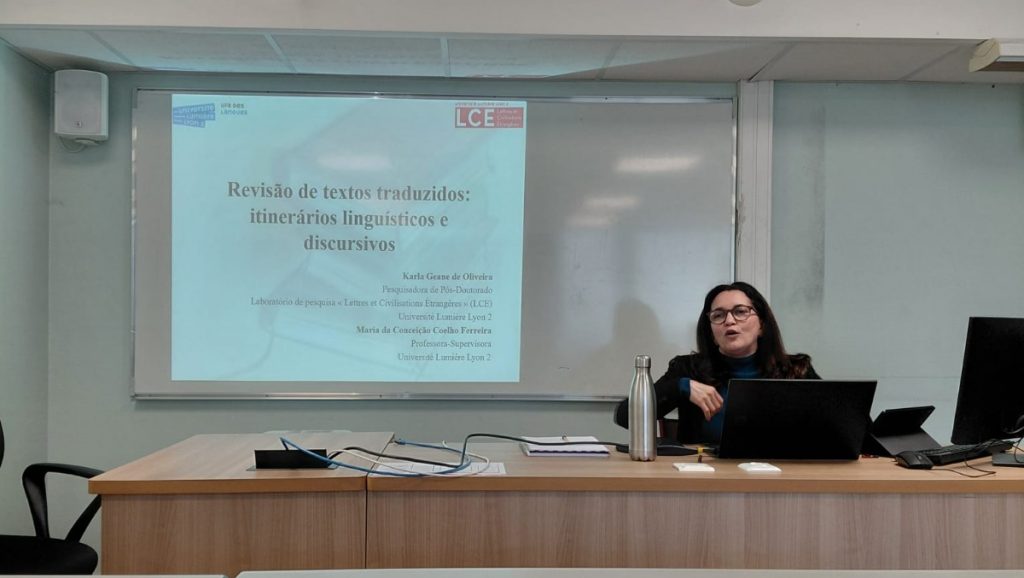
The employee at the Federal University of Rio Grande do Norte (UFRN), Karla Geane de Oliveira, responsible for text review activities at the Center for Human Sciences, Letters and Arts (CCHLA), is carrying out a post-doctoral internship at Université Lumière Lyon 2, in Lyon, France. During the period, she presented a work that articulates her professional practice at CCHLA with the research developed during her post-doctorate.
Entitled Review of translated texts: linguistic and discursive itineraries, the study aims to discuss the specificities of reviewing translated texts, especially those from French to Portuguese.
According to the researcher, the investigation is directly related to the activities carried out at the university. “The work I presented came from the activities I carry out at CCHLA, particularly within the scope of reviewing academic texts”, he states.
Experience in linguistic and discursive analysis of texts in the area of Human Sciences allowed us to identify recurring challenges in this type of review. “From my professional practice I was able to identify specific challenges related to reviewing translations, especially from French to Portuguese”, he highlights.
The researcher also emphasizes that practical experience has supported theoretical development in post-doctoral studies. “This experience is serving as a basis for the theoretical reflection developed in the post-doctorate and combines practice and research, contributing to further qualify the review activities carried out at CCHLA”, he explains.
International training has broadened your academic perspective. “The postdoctoral experience in France has been extremely enriching, both from an academic and professional point of view”, he highlights. She adds that “contact with other theoretical approaches and dialogue with international researchers significantly expanded my understanding of the practice of text revision”.
She also highlights the role of CCHLA in her academic and professional trajectory. “In this training journey, CCHLA played a fundamental role, as it was from institutional demands and experiences that the questions that guide my research today emerged”, he points out.
Finally, the server emphasizes the importance of academic support. “Institutional support was essential to make this training possible, reinforcing the center’s commitment to the continuous qualification of its employees and the production of knowledge relevant to the area”, he concludes.