
The II Maurice Blanchot International Colloquium “The Placeless Displacement of Thought” | Le déplacement sans place de la pensée, will take place between the 1st and 4th of September 2025 at the Federal University of Paraná (UFPR) in person and online and will bring together national and international teachers, researchers and students around the contemporary philosophical, literary and political issues of Maurice Blanchot's thought. This event proposes a set of conferences and communications with the aim of promoting an interdisciplinary dialogue at an international level, strengthening research networks, highlighting their influence on philosophy, literature and the arts, as well as strengthening philosophical, literary and cultural exchange based on Blanchot's work.
“Where does this come from, this power of extermination, destruction or change, in the first words written in the face of the sky, in the solitude of the sky, words in themselves without future and without pretension: “he – the sea”? It is certainly satisfying (too satisfying) to think that, by the simple fact of something like these words “he – the sea”, with the demand that results from them and from which they also result, the possibility of a radical transformation is written, inscribed somewhere, even if only for one, that is, of its suppression as a personal existence. Possibility: nothing more.” (Le Pas Au-Delà, 1973, p.8).
The maritime argument in Maurice Blanchot's work suggests and provokes an incessant displacement of everything that is intended to be rigid, stable. At different moments in his critical, philosophical and literary production, the sea appears as an image that is repeated but not fixed, nor does it allow stability for those who dive in it or the safety of a port for those who decide to sail it. The sea? On the edge, it is the edge, it knows no rest or defined contours; it is a point of contact between ocean and continent, a threshold point, like the one where thought and language meet fleetingly. Open, the sea is an exile of totalizing understanding, a space in which experience is faced with [transgresses from] its own limit, becoming a borderline experience, or even, it is the outside to which language points without ever reaching it. Both origin and impossible horizon, from this maritime exteriority manifests the neutral, principle of indeterminacy that suspends duality and disturbs language, the impersonal and sliding presence of a force that, ultimately, would lead language to disappearance. From the encounter between wave and shore, between outside and neutral, land and land, which touch in a fleeting instant, becoming confused without ever merging – a meeting that is always gaping and incomplete –, a foam emerges that belongs neither to the sea nor to the land. Foam that leads to the limit, to the edge without an inner edge to all transgression, which does not allow itself to be appropriated by any dialectical system.
The sea, in Blanchot's work, is this infinite metaphor, neither symbol nor allegory, just image. Space contrary to space, because displacement and indeterminacy; absent geography in which reading and writing oscillate, in which one witnesses and experiences “between two shores, as between two languages, the invisible sharing but also the abyss of an ocean”. In Thomas l’Obscur (1941, 1950), the sea is not a crossing, but a crossing: right at the beginning of the narrative, this undecidable in-between place of the water element not only leads us but also attracts us in its force of upheaval. So, a simple opening like “Thomas sits and looks at the sea.” (1950, p. 9, our translation) moves us to the character's ambiguous uncertainty in the face of immensity, like that of someone who, about to delve into the words and the mutations that they will operate in thought, stands in front of the blank page and writes, approaches a meaning only to see it empty then, runs the risk of drowning or even realizing that there was never any water. In this recitation, the recurrence of certain narrative elements gives form to a spectral repetition amidst the decentering of the “protagonist”, they are foams that dissolve at the same moment they appear, traces-witnesses of the metamorphic state, of the impossible coincidence between Thomas and the water in which he is lost.
What questions does Maurice Blanchot's thought continue to illuminate as he preserves, in its errancy and opacity, the sea that animates him? In what ways does this thought mobilize us in its displacement, making (re)appear what only the negative force has another name for, one that I call
Also read
Registration open for short course on autobiographies and participatory audiovisual research
Registration is now open for the short course “Autobiographies and Participatory Audiovisual Research”, which will take place on October 10th and 11th, 2024, at the UFRN Central Campus, Sector 2, Room C5. The event will be attended by the renowned Dr. José Ribeiro from the Institute for Research in Design Media and Culture at the…
Continue reading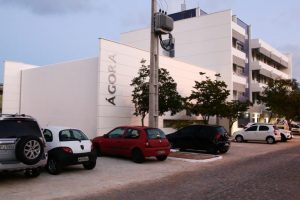
UFRN opens selection for Spanish Language scholarship at Instituto Ágora
The coordination of Instituto Ágora launched a notice for the selection of a Spanish Language scholarship for students on the Bachelor of Arts – Spanish course at the Federal University of Rio Grande do Norte, Campus Natal. The opportunity provides for the granting of a CONSAD Scholarship to work as a teaching intern in courses…
Continue readingDepartment of Communication holds election for Coordination of the Journalism Course
The election for Coordination of the Journalism Course at UFRN takes place this Thursday 24th. The single ticket “Innovation, Democracy, Efficiency and Equality” is running for the election. The panel is made up of professors Francisco de Assis Duarte Guimarães and Valquíria Aparecida Passos Kneipp, both from the Department of Communication (Decom/CCHLA). Voting will take…
Continue readingApocalyptic and disintegrated: criticism and alternatives to attention capture devices
On Thursday, June 5th, the meeting “Apocalyptic and disintegrated: criticisms and alternatives to attention capture devices” will take place. The event, which will feature the participation of researchers in philosophy, literature, arts and history, starts at 2:30 pm, in auditorium D of the CCHLA. Registration via Sigaa. About “Apocalyptic and disintegrated”. The time we have…
Continue reading