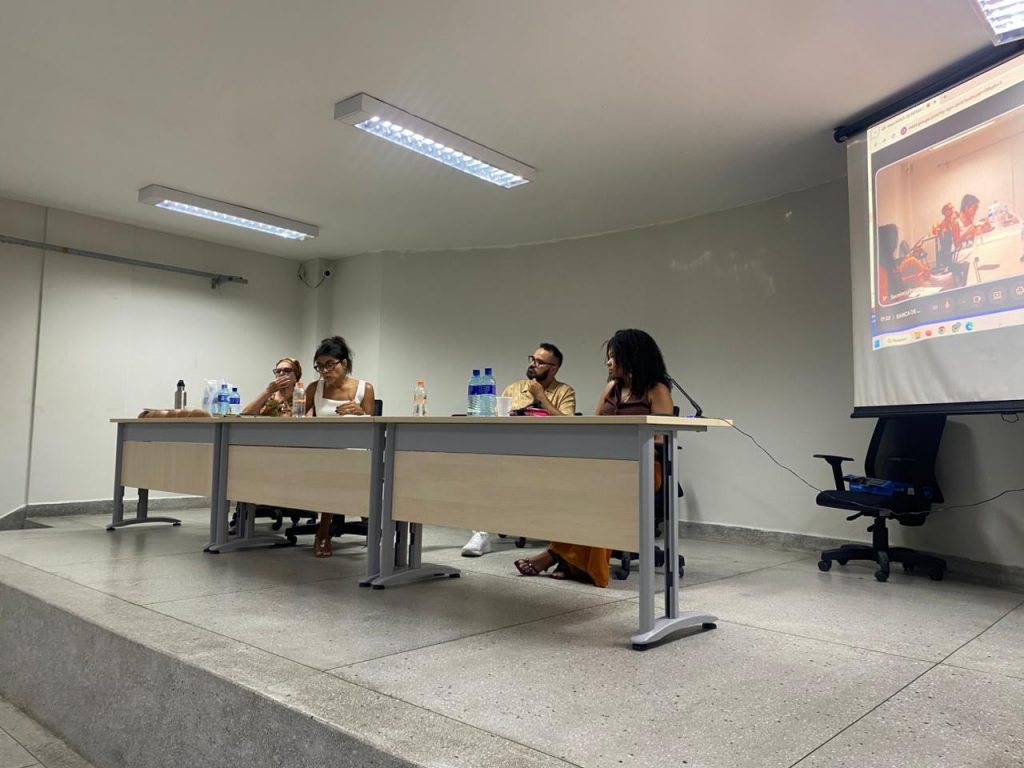
The Postgraduate Program in Social Sciences (PPGCS), linked to the Center for Human Sciences, Letters and Arts (CCHLA) at the Federal University of Rio Grande do Norte (UFRN), held on Friday, the 6th, in Auditorium B of CCHLA, the first doctoral defense of a quilombola student.
Postgraduate student Maria Janaina Silva dos Santos defended the thesis “When we became quilombola: an ethnography of black people from Talhado”, under the guidance of professor Anaxsuell Fernando da Silva. The research analyzes the quilombos of Talhado (PB) based on an autoethnographic study of black people in their search, as citizens, for collective rights. The work observes the trajectory of struggle and resistance of this population, as well as their experiences in the territories from their social formation to the process of becoming political citizens.
Maria Janaina explains that the research was built on her own experience as a member of the community studied. “The process was a journey of ‘return and affirmation.’ Carrying out an ethnography about the Talhado as part of it required a constant effort to balance the researcher’s perspective with the quilombola’s experience.”, he says.
According to her, the doctorate went beyond the traditional space of academic research. “It was not a doctorate just about offices and books, but about attentive listening to our bases and translating ancestral knowledge into academic language.” The researcher also highlights the methodological and political challenges faced when developing the study. “It was a methodological and political challenge to occupy this space at UFRN, putting pressure on the Social Sciences so that they also learn to read the world based on our technologies of resistance.”
Maria Janaina states that being the first quilombola to defend a thesis on the program carries collective meaning. “I feel like I don’t open this door alone; I enter accompanied by all those who came before me and who were prevented from accessing these spaces.” For her, the achievement also highlights the need to expand the presence of quilombola people at the university. “Being the first quilombola in the program is, at the same time, an honor and a reflection of how much the academy still needs to improve.”
The researcher adds that she hopes the experience will contribute to expanding other quilombola people's access to academic training. “I feel that this door now remains open so that others no longer need to be ‘the first’, but that the access of quilombola people to the top of academic training becomes the rule, and not the exception.”
Maria Janaina also relates her research to the concept of good living and the role of knowledge in social transformation. “It is the realization of the project of ‘living well’ through knowledge.” By quoting historian Beatriz Nascimento, the researcher reflects on the way the black population has been historically treated by academia. “As Beatriz Nascimento said, ‘you don’t study black people who are living.’ For a long time, academia looked at us as a past to be catalogued.”
For her, her thesis seeks to change this perspective. “My doctorate reverses this logic: I study the quilombo that vibrates, that fights and that reinvents itself today.” The researcher concludes by explaining the positioning of her research. "I don't study 'the other'; I narrate ourselves from experience, transforming living memory into science. And the UFRN social sciences program contributes to a narrative from the inside out.", he concludes.