
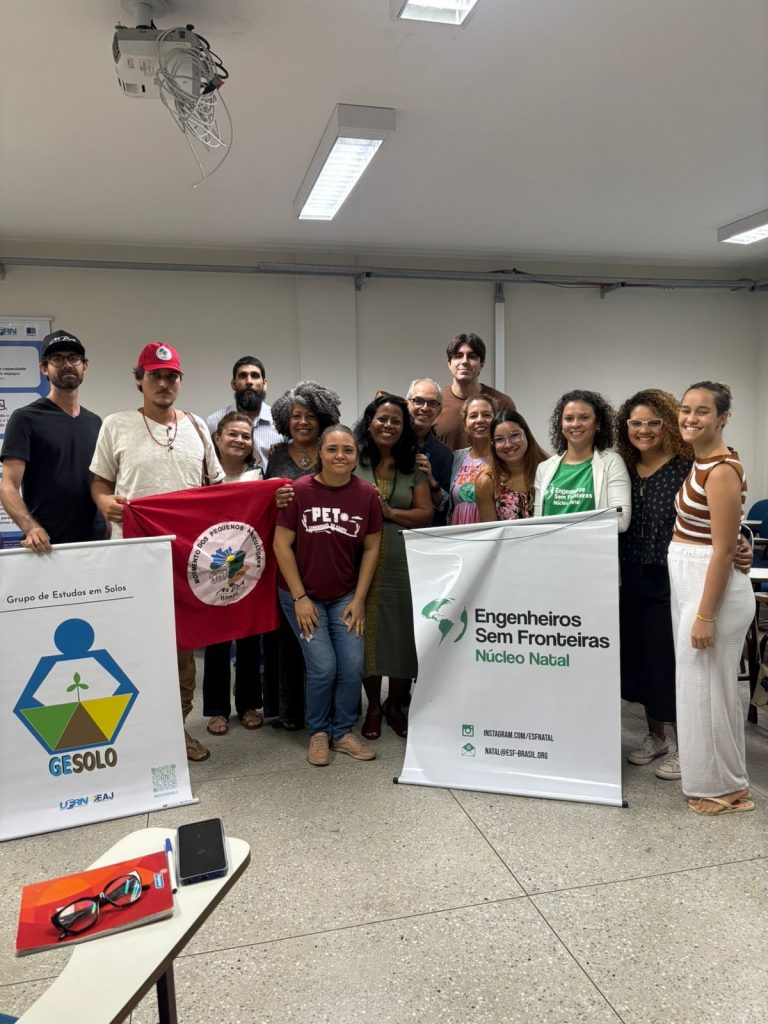
The Mandala Strategic Planning Meeting (UFRN Agroecology Studies Center) was held on February 11 and 12, 2026. The meeting brought together Mandala partner institutions and collectives with the aim of discussing the objectives and goals that will guide the center's actions throughout 2026, strengthening the articulation between universities, social movements and organizations that work in the field of agroecology and rural development.
Present were representatives of the State Secretariat for Rural Development and Family Agriculture of RN (Sedraf/RN), the Technical Assistance and Rural Extension Company of RN (Emater/RN), the Federal Institute of Rio Grande do Norte (IFRN), the Landless Rural Workers Movement – MST Potiguar, the Small Farmers Movement (MPA/RN), the Support Service for Alternative and Community Projects (Seapac), the Soil Study Group of Jundiaí Agricultural School (Gesolo/EAJ), the Rural Studies Laboratory (Labrural/IPPS/UFRN), the Engineers Without Borders Social Technologies Incubator – ESF Natal, the Quilombola Capoeiras Community (Macaíba/RN), as well as undergraduate and postgraduate students from UFRN, technical course students from the Jundiaí Agricultural School, technical professionals and other core partners. More than planning, it was a space for listening, dialogue and strengthening partners.
The official launch of the Mandala Agroecology Studies Center is scheduled for March 12, 2026, at 9 am, in the Auditorium of the Technology Center (UFRN, Natal), a moment that will publicly mark the beginning of the center's activities within the academic community and society.
NEA Mandala is a research, teaching and extension center in agroecology and organic production, linked to UFRN and supported by notice CNPq/SG-PR/MDA/MDS/MPI/MS no. 01/2025.
The nucleus is built by the Rural Studies Laboratory (LabRural) at UFRN, the Soil Study Group (GeSolo) at EAJ/UFRN and the Floema Project of the Social Technologies Incubator Engenheiros Sem Fronteiras (ESF-Natal) at UFRN.
Among the objectives are the implementation of Agroecological Reference Units in the territories of Trairi and Mato Grande, in addition to strengthening the Pedagogical Agroforestry of the Jundiaí Agricultural School, the development of training and practical actions that integrate research, teaching and extension, valuing local knowledge and promoting productive autonomy, community protagonism and food sovereignty.
“We believe in an agroecology that transforms realities, strengthens communities, builds food and nutritional sovereignty, and takes care of the land with justice and collectiveness.”
Instagram: @mandalanea