
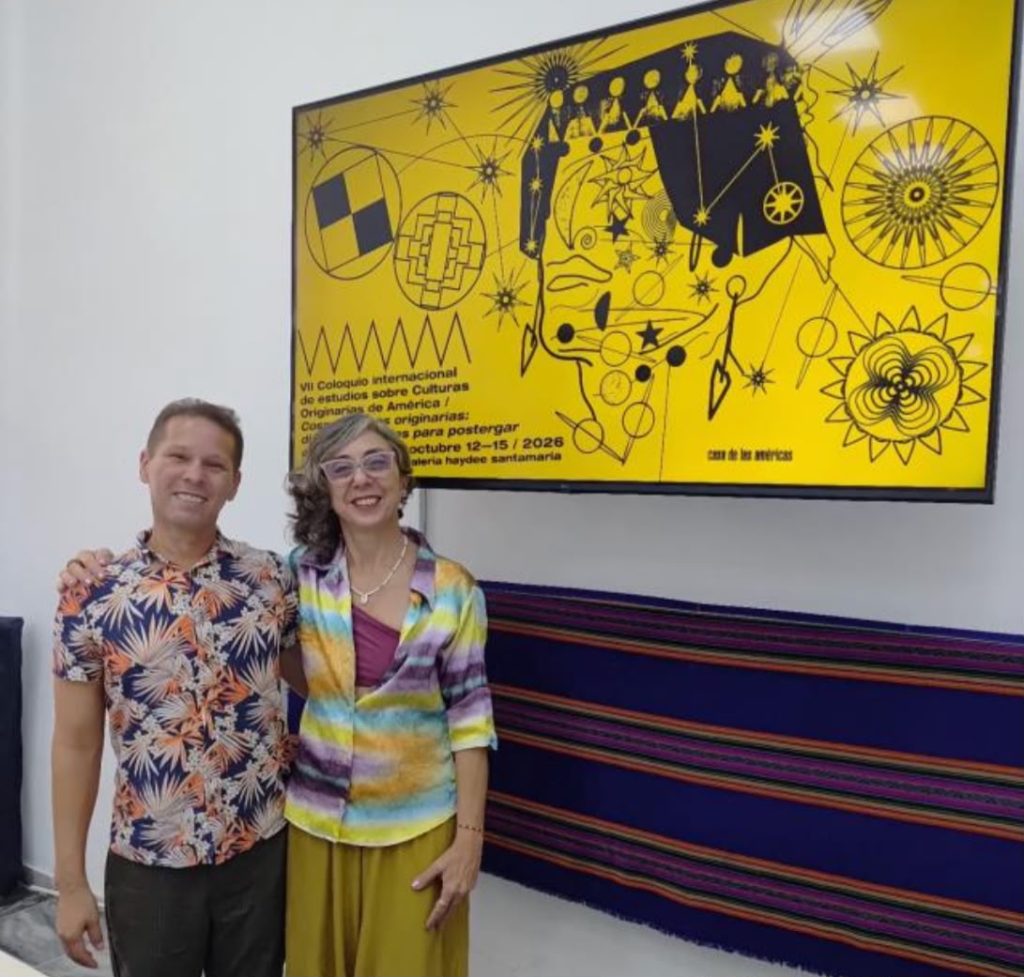
Professors from the Department of Arts at the Federal University of Rio Grande do Norte (UFRN) Marcilio de Souza Vieira and Roberta Maria Zambon Maziero participated, in October 2026, in the VII International Colloquium on Studies on Original Cultures of America, held in Havana, Cuba. The event, entitled Original worldviews: urgent dialogues to postpone the end of the world, brought together researchers and representatives of indigenous communities from Cuba, Guatemala, Mexico, Canada and Brazil.
Linked to the Dance Degree course, the teachers presented works that relate dance to social practices, identity, cultural resistance and indigenous worldviews. The colloquium had an interdisciplinary character, with discussions that involved social studies, indigenous social practices, anthropology and dance art.
The activities took place at Galería Haydee Santamaría, a building attached to Casa de las Américas, in a space for dialogue between different areas of knowledge and appreciation of knowledge. The debates addressed possibilities of thinking and practicing postponing the end of the world, a concept discussed by indigenous thinker Ailton Krenak.
Professor Roberta Maria Zambon Maziero presented the panel Dancing to postpone the end of the world, with the work A Dança do Bem Viver: celebrating and imagining other worlds. The exhibition established dialogues with the studies of Alberto Acosta, Ailton Krenak, Paulo Freire, Hanna Limulja and José Castiano, in addition to addressing the methodological concept of Free Dance, developed during the researcher's doctorate.
The work discussed dance as an area of knowledge involved in social practices that promote awareness and imagination, especially as a collective space for creating other worlds. The presentation also addressed dance as a social, cultural, artistic and educational construction, in which the presence and movement of participants enable access to different repertoires of experiences and impressions.
Professor Marcilio de Souza Vieira presented the work Dancing to postpone the end of the world: Toré as a territorial body. The research addressed Toré and its centrality in the spirituality and sociocultural organization of several indigenous peoples in the Brazilian Northeast, including those in Rio Grande do Norte.
The presentation analyzed Toré as a bodily, ritualistic and political practice of identity and cultural resistance, which allows understanding the body as a space of experience, perception and production of meanings. The discussion dialogued with Ailton Krenak's reflections on the relationships between corporeality, territory, ancestry and indigenous cosmology.
During the event, Marcilio de Souza Vieira also presented the book O Toré and the memory of the indigenous peoples of Potiguar (2026), the result of research funded by the National Council for Scientific and Technological Development (CNPq).
The presentations and exchange of knowledge between the participants resulted in an invitation to publish the works presented in a Casa de las Américas magazine. The meeting also opened up possibilities for future partnerships between areas of knowledge such as education, art, sociology and anthropology.

