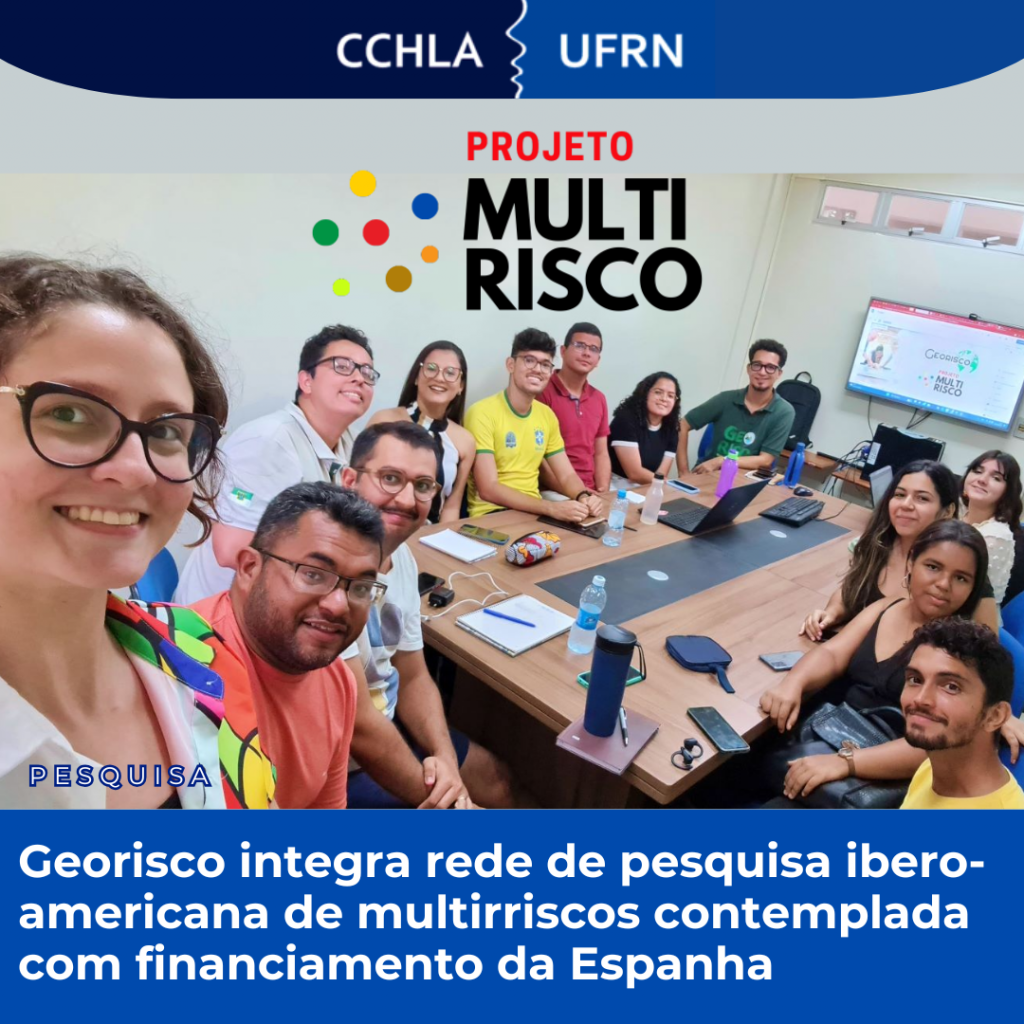
The Georisk Research Group, from the Federal University of Rio Grande do Norte (UFRN), through the Ibero-American multi-risk research network, was included in a program by the Superior Council for Scientific Investigations (CSIC), the largest Spanish public institution dedicated to scientific research and one of the most important in Europe. The project will study systemic risks in human settlements in the context of climate change.
According to the Georisk coordinator, Lutiane Almeida, the proposal promotes the integration and internationalization of scientific work that has already been carried out at UFRN for more than a decade. “Our proposal is to contribute to a better understanding of the impact of dangers related to climate change, such as heat waves, floods and extreme winds, on different types of human settlements, from rural areas in the process of depopulation to urban areas with population growth”, highlights Almeida.
This international project starts in September this year and will last three years, with around 37 thousand euros allocated to cover travel and daily expenses for the network's scientists to carry out research missions. The project team will take into account both the physical vulnerability of the environment and the social vulnerability of the people who live there. Three case studies are planned in the countries that are part of the network: Spain, Portugal, Brazil, Mexico and Chile.
The project proposal is welcome because the intersection between multi-threats and vulnerabilities, as part of a more integrated understanding of risk, is still little investigated. “Integrating this aspect can help identify priority areas where mitigation actions should be considered, in addition to informing public policy makers and emergency managers to prepare response measures and specific interventions in urban areas”, highlights the UFRN professor.
The collaboration also seeks to engage local communities in actions before and after the disaster, by encouraging participation and co-production of knowledge. This allows us to support the strengthening of community capacities. “Training and workshops will be developed to enable communities to share data, coordinate activities, compare preparedness strategies and participate in a collaborative, incentive-based model for disaster resilience,” says Almeida.
The Ibero-American multi-risk research network is coordinated by Tiago Ferreira, professor at the University of Lisbon (Portugal), Nuria Chiara Palazzi, professor at Universidad Andrés Bello (Chile), Adrià Sánchez Calvillo, post-doctoral fellow at Universidad Michoacana de San Nicolás de Hidalgo (Mexico), and Lutiane Almeida, professor at UFRN (Brazil). To follow the next steps of this project, follow the Georisco Instagram page: https://www.instagram.com/georiscoufrn/.
Georisco integrates Ibero-American multi-risk research network awarded funding from Spain