
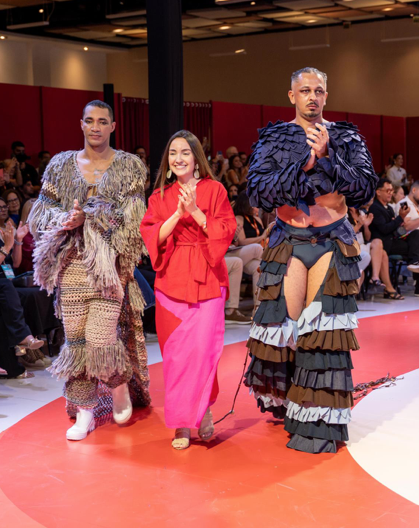
Research developed at the Federal University of Rio Grande do Norte (UFRN), with the participation of inmates from the Alcaçuz State Penitentiary, in Nísia Floresta, received an invitation to take part in New York Fashion Week, in February 2027. The Revoada Collection, created by the project participants, brings together 12 looks and 25 pieces produced using manual techniques, such as crochet, macramé, embroidery and yo-yo.
The initiative is part of the Tecendo Liberdades project, designed and coordinated by Jéssica Cerejeira, doctoral student of the Postgraduate Program in Performing Arts (PPGArC/UFRN) and volunteer collaborating professor at the Department of Arts (DEART). Developed since the beginning of 2026, the work combines theater, costume creation and professional training for people deprived of their liberty.
The project arose in dialogue with the Arkhétypos Theater Group at UFRN, coordinated by professor Sebastião de Sales Silva and founded by professor Robson Carlos Haderchpek, Jéssica's doctoral advisor. Professor Leônidas Oliveira, also from DEART, is part of the group, which also has five scholarship students.
A bird crossing
The artistic proposal is based on the book The Conference of Birds, by Peter Sís, which narrates the journey of a flock of birds in search of a king. At the end of the journey through seven valleys, the characters discover that what they were looking for was themselves.
The fable guides the revival of the show Revoada, by Grupo Arkhétypos, scheduled to premiere in September 2027. During the process, each participant creates their own bird. The experience is recorded in sensitive diaries, inspired by the methodology developed by researcher and professor Thulho Cezar Santos de Siqueira.
"Seeing the inmates giving themselves over to the game and recognizing themselves as subjects, as creative beings, has been revealing. Art has allowed us to break down barriers and has helped us to fly, even in a space where freedom is restricted", says professor Robson Haderchpek.
The activity is also part of Jéssica Cerejeira's doctoral research, entitled Incarcerated Fabrics: the costumes and the scene as a weaving of freedoms, guided by Haderchpek. The study investigates how costumes and scenes can act as identity resignification devices.
For Professor Sebastião Silva, the experience transforms both the interns and the team members. "When I see those men giving themselves over to creation, I realize that art opens gaps between walls and suspends time through esthesia. In this encounter, I am also transformed: their stories and gestures displace my certainties and expand my humanity."
The workshops feature the participation of five Arkhétypos scholarship students: Cadidja Alves Bezerra, Fanny Frasse Alberti, Graicy Awanny da Costa Machado, Layfson Gabriel da Silva Costa and Helton dos Santos Farias. For Helton, graduating in Theater, “theatre is even more challenging for a body that has changed with the rules of a space that compresses it”.
Anny Costa, a Theater major, also participates in the activities and describes the work as a process of “deconstructing bodies accustomed to having their heads down and arms behind their backs”. “Reteaching them to look into their eyes is to give back, even if a little, the humanity that was taken away,” he says.
From line to costume
Between March and July 2026, the proposal took shape in a sewing workshop. Fifteen inmates combined the images from the book with manual techniques they already mastered, such as crochet, macramé, embroidery and yo-yo. In the pieces, fringes were transformed into plumage, hats into crests and wide sleeves into wings.
The raw material used was donated by the National Industrial Learning Service of Rio Grande do Norte (SENAI-RN) and by companies in the textile sector: Uniformize, Vicunha Têxtil, Santana Têxtil, Bonor and Casa do Zíper.
The result was the Revoada Collection, made up of 12 looks and 25 pieces, designed as costumes that represent the bird persona of each creator. In July, the collection was presented at GINGA Moda RN, with live transmission into the prison unit.
One of the highlights of the parade was the participation of João Batista, a former inmate who had already regained his freedom. He walked the catwalk wearing the crochet cloak created in the collection. Currently, she works from home with her own sewing machines and produces bags to sell.
After the fashion show, a video about the collection was published
