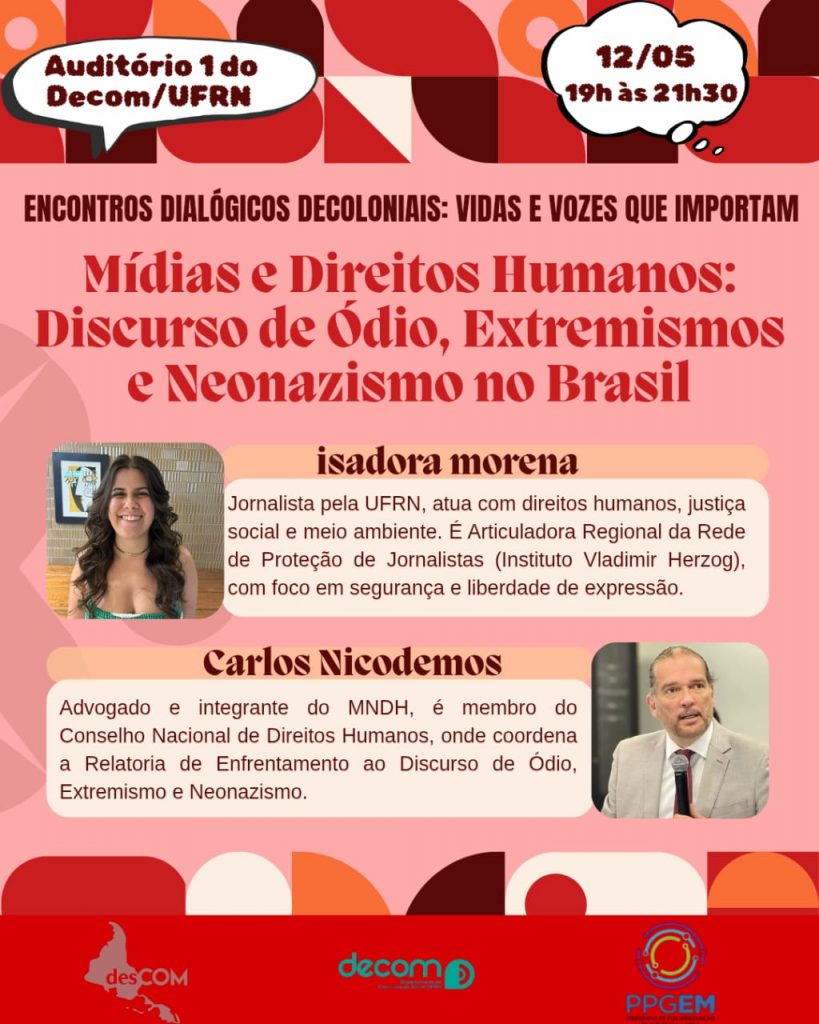
The Federal University of Rio Grande do Norte will hold, next Tuesday (12), the second meeting of the 2026.1 semester of the Decolonial Dialogical Encounters: Lives and Voices that Matter extension cycle. With the theme “Media and Human Rights: Hate Speech, Extremism and Neo-Nazism in Brazil”, the activity takes place from 7 pm to 9:30 pm, in Auditorium 1 of the Department of Social Communication (Decom), on the university's central campus, in Natal.
The event is promoted by the research group DESCOM – Decolonial Insurgencies, Communication, Arts and Humanities, linked to Decom and the Postgraduate Program in Media Studies. Created in 2020, the extension cycle promotes debates on contemporary themes from transdisciplinary, intersectional and anti-colonial perspectives, bringing together researchers, professionals and representatives of civil society.
In this edition, the meeting will discuss the impacts of hate speech, extremism and the expansion of neo-Nazi groups in Brazil, in addition to the challenges faced by communication and human rights in the face of the advancement of these practices. Among the guests is Carlos Nicodemos, a lawyer who is part of the National Human Rights Movement (MNDH) and member of the National Human Rights Council (CNDH), where he coordinates the Special Rapporteur for Combating Hate Speech, Extremism and Neo-Nazism.
The report was created by the CNDH in 2023, given the growth of hate speech and the expansion of neo-Nazi groups and cells in the country. Subsequently, its activities were expanded to monitor contemporary forms of discrimination and propose public policies and concrete measures to combat extremism and violence motivated by race, religion, gender, sexual orientation and other social markers.
Also participating in the debate is Isadora Morena, a journalist graduated from UFRN with a focus on communication committed to human rights, social justice and environmental issues. Currently, Isadora is a regional coordinator of the National Network for the Protection of Journalists and Communicators, an initiative coordinated by the Vladimir Herzog Institute in partnership with civil society organizations, social movements, communication collectives and entities defending freedom of expression.
The National Network for the Protection of Journalists and Communicators works to monitor complaints, formulate security and protection strategies for communication professionals and promote training aimed at guaranteeing freedom of expression and democracy. The initiative also has the support of Repórteres Sem Fronteiras and Intervozes – Coletivo Brasil de Comunicação Social.
Registration is free and open to both the academic community and the public outside UFRN. Registration can be carried out through SIGAA-UFRN, in the “Extension” menu, then “Events” or through the link (CLICK HERE) extension, searching for the title “DECOLONIAL DIALOGICAL MEETINGS: LIVES AND VOICES THAT MATTER” and following the instructions available on the platform.
SERVICEDecolonial Dialogical Meetings: Lives and Voices that Matter – 2nd Meeting of the semester 2026.1
DATE: May 12, 2026
TIME: 7pm to 9:30pm
THEME: Media and Human Rights: Hate Speech, Extremism and Neo-Nazism in Brazil
GUESTS: Carlos Nicodemus. Attorney. Member of the MNDH – National Human Rights Movement. Member of the National Human Rights Council coordinating the Special Rapporteur for Combating Hate Speech, Extremism and Neo-Nazism. Isadora Morena. Journalist graduated from the Federal University of Rio Grande do Norte (UFRN), regional coordinator of the National Network for the Protection of Journalists and Communicators, linked to the Vladimir Herzog Institute.
LOCATION: Auditorium 1 of the Department of Social Communication – UFRN
Follow the DESCOM research group on Instagram: @descomufrn